Present: Presenter Corissa Neufeldt, Marion County Human Services Director; Sarah Owens, Secretary; Members Chris Jones, Eddie Maestas, Dana Schultz, Michael Livingston (see
Roster tab, above).
Corissa spoke informally about what Marion County Human Services is doing at the intersection of health and housing. The Board of Commissioners has a leadership role in forming the Mid-Willamette Valley Homeless Alliance. The Juvenile and Sherriff's Department are also involved. Most of Marion County's housing services is supporting clients that the county serves through behavioral health services.
The Marion County Housing Authority sets aside 10 housing vouchers per month for homeless/at risk clients. These are shared between the Human Services, Juvenile, and Sherriff's Department, but Human Services uses most of them. Their clients have many barriers to accessing housing, even with a voucher (housing is not affordable, or not accessible, or not suitable because of other tenants, etc.) Corissa plans to work with Annette Jensen to cultivate relationships with owners and property managers. Annette prioritizes housing referrals based on need/vulnerability.
The county also has an OHA "Housing First" rent subsidy program for clients with Serious and Persistent Mental Illness and Substance Use Disorders. Clients in this program eventually move on to a voucher. The county Health Department runs Horizon House and other adult foster homes
Dana asked if the county would be interested in cooperating on a Permanent Supportive Housing project and Corissa said yes, she thought so. Dana and Annette had been to Eugene the day before to look at a reentry housing program
for sex offenders, and were hopeful about working together on similar project.
Pacific Source has contractual expectations that providers address housing as one of the social determinants of health. Corissa said the county is more or less waiting to hear more about those expectations. Dana said she'd met
with interim director Trudy Townsend, who said once the Mid-Willamette Valley Health Council was assembled, providers would be invited to make
proposals on how they propose to satisfy their contractual obligations, and the Council will decide whether or not to approve them. Pacific Source has yet to settle on a director or a location, but will eventually have about 40 staff in a Salem office.
Dana said that Jan Calvin is conducting one on one meetings with providers to get them "signed on" to the Built for Zero goals. The aim is to involve every organization who is connected to a homeless individual or
to the desired outcome for the homeless individual. Providers have to commit to twice per month case conferencing. The by-name list will focus on chronically homeless individuals. Lane, Clackamas, and Washington counties are also participating. Participants report to an "improvement advisor" named Sandy
Coltz who is also available for technical assistance. See here for an info sheet with more details.
The next meeting is scheduled for February 10.
Showing posts with label Mtg Notes. Show all posts
Showing posts with label Mtg Notes. Show all posts
Monday, January 13, 2020

Sunday, November 24, 2019
18 November 2019 Meeting Notes
Present: Sarah
Owens, Secretary; Members Michael Livingston, Jan Calvin, Kimm McBeth; Guest Janet Carlson (see
Roster tab, above).
Report on the distribution of CANDO's Good Neighbor Guide:
Visited 72 downtown Salem businesses and spoke with owner or manager at
29 of them. Guide received a uniformly positive response, and most
immediately read it. Some asked for extra copies for employees. “Very
helpful”
Asked if business had problems with "homeless" individuals?
- 15 “too busy to talk”
- 11 “not mentioned”
- 13 no problems, or no current problems
- 8 “yes, but no specifics”
- 15 occasional, or infrequent (intoxicated; “alternate reality; unruly person asked to leave; people drunk or using drugs at sidewalk restaurant tables; people sleeping in doorways when staff arrive
- 4 on High St north of Marion (2 based on previous contacts) identified continuing serious problems -- e.g., vandalism and people mentally ill and out of control) Owner of one of those businesses spoke highly of Be Bold Street Ministries staff -- Josh & Matt, whose contact information is in the pamphlet
Asked if business did have any problems, how handled?
- 10 relational approach (asking people to leave) & call police as needed
- 3 security guard
- 8 relational approach only
- 4 other (e.g., call police & coordinate with nearby businesses; complain to mayor & council; call Be Bold Street Ministries)
Nicole offered tours of SHA's Immediate Needs Station to which law enforcement has 24/7 access.
Discussion: Mid-Willamette Valley Homeless Alliance's Built for Zero project; canceling December Health & Housing Work Group meeting to allow members to attend the Thursday, December 5 MWVHA meeting for area providers to discuss progress on forming the new continuum of care (9-10:30 at the Keizer Civic Center).
Discussion: Mid-Willamette Valley Homeless Alliance's Built for Zero project; canceling December Health & Housing Work Group meeting to allow members to attend the Thursday, December 5 MWVHA meeting for area providers to discuss progress on forming the new continuum of care (9-10:30 at the Keizer Civic Center).
Monday, October 21, 2019
14 October 2019 Meeting Notes
Present: Presenters Eunice Kim and Scott Eastburn; Sarah Owens, Secretary; Members Eddie Maestas, Christie Hughes, Kristin Keunz-Barber, Shelly Ehenger, Michael Livingston, Chris Jones (see Roster tab, above).
Shelly Ehenger: The draft 5-year Consolidated Plan is available for comment. The City is working with Western Economic Services. Only ~80 or so people responded to the survey, which is open through March if you haven't yet taken it or want to change your answers.
Eunice Kim: The City is in the midst of a multi-year project to update the Salem Area Comprehensive Plan, which guides development in the Salem area. The project is called Our Salem, and is in the "community-wide visioning" phase. Sign up to get email updates about the project and learn about opportunities to get involved.
Scott Eastburn: The ARCHES Project has launched a new housing program with three components based on a client's VI-SPDAT score, and three funding sources. Four case managers, 15-25 client caseload. Intent is to match services/support with need. Expectation is one check-in/month and a six-month follow up after exit. Key performance measure is housing stability; aim to house 95% of those going through intake, and have 90% exit to positive housing situation. Program strengths: cultivated relationships with landlords; uniform forms; rapid, assisted intake; removing barriers before the housing search begins (e.g., help client complete out a standard lease application and practice interview), move in checklists to work while the client is waiting for the inspection to be completed; having staff certified to be able to inspect; solid relationship with Fair Housing. Maximum assistance is for two years, but most will exceed income standard (30% of gross) in six months. More details in Scott's outline (edited somewhat).
There is nothing yet planned for November, the work group having rejected Sarah's idea to hold a debate on the merits of the City's proposed Sidewalk Behavior Ordinance. Kristin Keunz-Barber agreed after the meeting to see if someone from Marion County's Health Advisory Board might be prepared to talk to the work group in November about HAB's interface with housing and homelessness.
Shelly Ehenger: The draft 5-year Consolidated Plan is available for comment. The City is working with Western Economic Services. Only ~80 or so people responded to the survey, which is open through March if you haven't yet taken it or want to change your answers.
Eunice Kim: The City is in the midst of a multi-year project to update the Salem Area Comprehensive Plan, which guides development in the Salem area. The project is called Our Salem, and is in the "community-wide visioning" phase. Sign up to get email updates about the project and learn about opportunities to get involved.
Scott Eastburn: The ARCHES Project has launched a new housing program with three components based on a client's VI-SPDAT score, and three funding sources. Four case managers, 15-25 client caseload. Intent is to match services/support with need. Expectation is one check-in/month and a six-month follow up after exit. Key performance measure is housing stability; aim to house 95% of those going through intake, and have 90% exit to positive housing situation. Program strengths: cultivated relationships with landlords; uniform forms; rapid, assisted intake; removing barriers before the housing search begins (e.g., help client complete out a standard lease application and practice interview), move in checklists to work while the client is waiting for the inspection to be completed; having staff certified to be able to inspect; solid relationship with Fair Housing. Maximum assistance is for two years, but most will exceed income standard (30% of gross) in six months. More details in Scott's outline (edited somewhat).
There is nothing yet planned for November, the work group having rejected Sarah's idea to hold a debate on the merits of the City's proposed Sidewalk Behavior Ordinance. Kristin Keunz-Barber agreed after the meeting to see if someone from Marion County's Health Advisory Board might be prepared to talk to the work group in November about HAB's interface with housing and homelessness.
Thursday, September 12, 2019
9 September 2019 Meeting Notes
Present: Sarah Smith, Chair, and Sarah Owens, Secretary; Members Eddie Maestas, Jan Calvin, Rob McAdam, Eunice Kim, Christie Hughes, Dana Schultz, Kristin Keunz-Barber, Shelly Ehenger (see Roster tab, above).
Mid-Willamette Valley Community Action Agency and Salem Housing Authority Projects: MWVCAA's Director of Program Development and SHA's Administrator Nicole Utz gave the presentation. Joint projects included Redwood Crossings (fka "Fisher Road") and Sequoia Crossings (3120 Broadway St. NE). Also discussed Yaquina Hall construction delays, HRAP (report on 2018 coming out soon), SHA's application for 75 mainstream NED vouchers, its progress on the RAD Project, the switch to SAFMRs, CCO 2.0-related changes, and what it means that Salem has opted against enacting a inclusionary zoning and construction excise tax in favor of "incentives." See, e.g., Brynelson, T. "Hoping for affordable apartments, Salem eyes new twist on urban renewal" (September 11, 2019, Salem Reporter.)
Housing programs administered by MWVCAA's ARCHES Project is on the agenda for October 14 (a federal holiday [Columbus Day] but the Salem Housing Authority office will be open). SHA will be closed for Veterans Day, so November's meeting has been moved to November 18. The last meeting of 2019 will be December 9.
 |
| Yaquina Hall |
Housing programs administered by MWVCAA's ARCHES Project is on the agenda for October 14 (a federal holiday [Columbus Day] but the Salem Housing Authority office will be open). SHA will be closed for Veterans Day, so November's meeting has been moved to November 18. The last meeting of 2019 will be December 9.
Monday, July 15, 2019
8 July 2019 Meeting Notes

 |
| Yamhill Carlton gym February 2018 dome inflation |
The Carlton-Yamhill gymnasium built in 2018 is a monolithic dome. (For a brief video on "ecoshell" construction, see here.)
The biggest hurdle is land. United Way is able to pursue one land purchase at a time. The Mill City development is "on hold for a number of reasons", but United Way is pursuing a lead on a piece of property in the neighborhood.
Regional CoC Developments: Jan Calvin shared information about the second meeting with area homeless services providers (see "HUD Joins 2d Regional CoC Providers Convo"), a project time line, and a chart showing which entities will probably be on the CoC Development Council. Asked about Yamhill County's possible reconsideration if its decision to remain in the ROCC, she advised that the meeting between Yamhill County and Yamhill County mayors had still not been scheduled. She also advised that a memorandum of agreement was in the process of being vetted by all parties' legal counsel.
It was agreed unanimously to cancel the August meeting, and reconvene on September 9, at the usual time and place.
 |
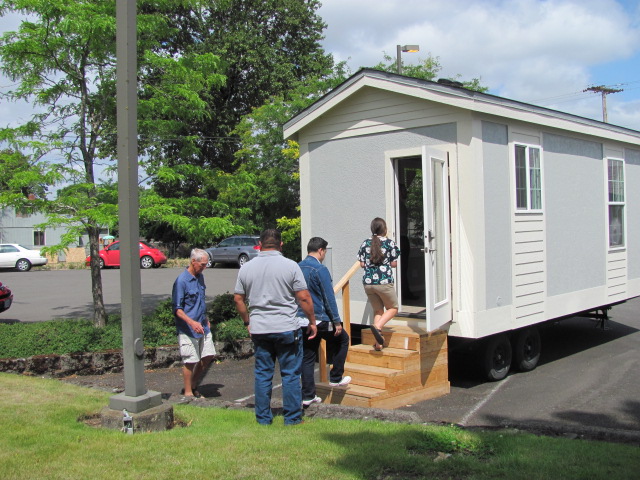
| Members Rebecca Knight and Pamala Garrick in the Green Flex unit |
Thursday, June 13, 2019
10 June 2019 Meeting Notes
Present: Sarah Smith, Chair, and Sarah Owens, Secretary;
Presenters Emily Reiman, Jimmy Jones, William Strawter, Harley Merck (new); with
Members Pamala Garrick, Eddie Maestas, Kristin
Kuenz-Barber, Rebecca Knight, Erin Grimshaw (new),
Shelly Ehenger, Dana Schultz (new), Chris Jones, and Michael Livingston (see Roster
tab, above).
Regional CoC Developments: following up on the discussion at last month's meeting regarding the effort to form a regional Continuum of Care (CoC), Emily Reiman shared with the group NEDCO's experience with the CoCs in Lane and Clackamas counties. She said Lane County's CoC appeared to be inclusive (lots of open meetings, etc.,), that was not her experience when trying to apply for funds. She said the same legacy grantees were funded year after year, despite questions in the community about their effectiveness. It might even be the case that Lane County doesn't accept new project applications. The Clackamas CoC was quite the opposite. Emily said she had shared this with the consultant to the Mid-Willamette Homeless Initiative Steering Committee, Jan Calvin, and hoped the steering committee would strive to be inclusive when making governance decisions regarding the new regional CoC.
Salem, Polk and Marion counties have adopted resolutions supporting formation of a regional CoC. Yamhill County initially declined support, but might reconsider. There is division within Yamhill on the issue. A clear majority vote in favor of separation is needed to satisfy HUD. Yamhill also faces a timing issue. The late May/early June deadline for adopting a resolution in support has passed, however any decision rests with the MWHI Steering Committee, which meets on June 25 from 3 to 5 at the Mid-Willamette Council of Governments.
Permanent Supportive Housing: continuing his introduction to PSH using Lincoln Place, Vancouver WA, as a model of PSH congregate care, Jimmy Jones shared his experience with Salem's Homeless Rental Assistance Program (HRAP), which uses a scattered site model. The formal program managed by the Salem Housing Authority (SHA) was launched July 2017 to serve the area's most vulnerable chronically homeless families/individuals. Its success largely has depended on the availability of privately owned rental housing. Participants were and continue to be referred by The ARCHES Project from a master list based on assessments using the VI-SPDAT and VAT. Currently, participants are supported by three case managers (Christine Jeffries, Eddie Maestas and Jack Elliott) and SHA's Client Services Manager, Kimm McBeth.
As the program heads into its third year, 121 participants have been housed, 2 have died, 15 have been evicted, and 2 have left for other reasons. The program budget and goals were recently "right-sized" (halved) to match what's felt to be realistic based on the limited housing supply, a move that caused concern within the community about the success of the program. On May 28, City officials met with providers to "discuss shifting resources to slightly lower needs clients than the 'hardest to house'" (see Bach, J. "Can Salem continue to pay for its 'housing first' program to get homeless off the streets?" (29 May 2019, Statesman Journal.)
During the meeting, Jones was asked what circumstances might justify shifting the program focus to lower needs clients, and whether doing so was likely to affect outcomes. The discussion was just getting started when it was time to move on with the agenda, but it will be resumed at a subsequent meeting. (In the interim, members might be interested to read this Permanent Supportive Housing Study, which concluded, "based on the variables included, there would have been no way to predict at entry into permanent supportive housing who would stay or leave, either positively or less so.")
 Presentation: Harley Merck and William Strawter presented a proposal for a project that would explore: 1) the use of existing state and county models to develop tiny home communities by private individuals or businesses;
4) overall profitability for the private or business investor; and
5) result in a deliverable business plan to be used by low income housing advocates to encourage private land owners and developers to build tiny villages, as both a benefit to the community and a viable business investment.
The group offered comments and suggestions, including taking a look at The United Way of the Mid-Willamette Valley's efforts in this area.
Action: the work group also adopted a charter (see tab above).
Regional CoC Developments: following up on the discussion at last month's meeting regarding the effort to form a regional Continuum of Care (CoC), Emily Reiman shared with the group NEDCO's experience with the CoCs in Lane and Clackamas counties. She said Lane County's CoC appeared to be inclusive (lots of open meetings, etc.,), that was not her experience when trying to apply for funds. She said the same legacy grantees were funded year after year, despite questions in the community about their effectiveness. It might even be the case that Lane County doesn't accept new project applications. The Clackamas CoC was quite the opposite. Emily said she had shared this with the consultant to the Mid-Willamette Homeless Initiative Steering Committee, Jan Calvin, and hoped the steering committee would strive to be inclusive when making governance decisions regarding the new regional CoC.
Salem, Polk and Marion counties have adopted resolutions supporting formation of a regional CoC. Yamhill County initially declined support, but might reconsider. There is division within Yamhill on the issue. A clear majority vote in favor of separation is needed to satisfy HUD. Yamhill also faces a timing issue. The late May/early June deadline for adopting a resolution in support has passed, however any decision rests with the MWHI Steering Committee, which meets on June 25 from 3 to 5 at the Mid-Willamette Council of Governments.
Permanent Supportive Housing: continuing his introduction to PSH using Lincoln Place, Vancouver WA, as a model of PSH congregate care, Jimmy Jones shared his experience with Salem's Homeless Rental Assistance Program (HRAP), which uses a scattered site model. The formal program managed by the Salem Housing Authority (SHA) was launched July 2017 to serve the area's most vulnerable chronically homeless families/individuals. Its success largely has depended on the availability of privately owned rental housing. Participants were and continue to be referred by The ARCHES Project from a master list based on assessments using the VI-SPDAT and VAT. Currently, participants are supported by three case managers (Christine Jeffries, Eddie Maestas and Jack Elliott) and SHA's Client Services Manager, Kimm McBeth.
As the program heads into its third year, 121 participants have been housed, 2 have died, 15 have been evicted, and 2 have left for other reasons. The program budget and goals were recently "right-sized" (halved) to match what's felt to be realistic based on the limited housing supply, a move that caused concern within the community about the success of the program. On May 28, City officials met with providers to "discuss shifting resources to slightly lower needs clients than the 'hardest to house'" (see Bach, J. "Can Salem continue to pay for its 'housing first' program to get homeless off the streets?" (29 May 2019, Statesman Journal.)
During the meeting, Jones was asked what circumstances might justify shifting the program focus to lower needs clients, and whether doing so was likely to affect outcomes. The discussion was just getting started when it was time to move on with the agenda, but it will be resumed at a subsequent meeting. (In the interim, members might be interested to read this Permanent Supportive Housing Study, which concluded, "based on the variables included, there would have been no way to predict at entry into permanent supportive housing who would stay or leave, either positively or less so.")

2) community concerns for tiny home developments;
3) county and city regulations, ordinances, building codes, safety concerns, and security concerns;
5) result in a deliverable business plan to be used by low income housing advocates to encourage private land owners and developers to build tiny villages, as both a benefit to the community and a viable business investment.
The group offered comments and suggestions, including taking a look at The United Way of the Mid-Willamette Valley's efforts in this area.
Action: the work group also adopted a charter (see tab above).
Tuesday, May 14, 2019
13 May 2019 Meeting Notes
Present: Sarah Smith, Chair, and Sarah Owens, Secretary; Presenters Jan Calvin (new), Alison McIntosh, and Jimmy Jones; with Members Pamala Garrick, Kim McBeth, Christie Hughes, Kristin Kuenz-Barber, Rob McAdam, Rebecca Knight, Jeramy Steele, William Strawter (new), Carolyn Fry (new), Connor McDonnell, Emily Reiman, Shelly Ehenger, Cameron Ross (new) and Michael Livingston (see Roster tab, above).
Guests: Dede Hazzard and Raleigh Kirschman, both with the Union Gospel Mission Men's Shelter.
Jan Calvin, consultant to the Mid-Willamette Valley Council of Governments and the Mid-Willamette Homeless Initiative Steering Committee, gave a presentation on the steering committee's recommendation to (re) establish a local Continuum of Care.
Links to a white paper and the long form of the presentation are posted on the May 13 Agenda. Emily Reiman said she had experience working with the CoCs to the north (Clackamas County) and south (Lane County) and agreed to share a few remarks about her experience at the June meeting.
The members present agreed to provide a letter supporting the establishment of a local CoC. See here.
Alison McIntosh with Neighborhood Partnerships/Oregon Housing Alliance provided a legislative update and answered questions. The last revenue forecast is due out soon, at which point lawmakers will know what they have to work with. The Governor wants $20.5M in General Fund dollars for homeless families and $50M for permanent supportive housing. HB 2802 would provide aging-in-place resources.
Jimmy Jones offered remarks on permanent supportive housing (PSH) models generally (scattered site versus congregate) and his experience with Lincoln Place, a permanent supportive housing project developed by a partnership between Share, the Council for the Homeless, the Vancouver Housing Authority (vouchers) and Key Property Services. Among the lessons learned was the importance of putting the right people next to the right people and designing for people with a heightened/extreme sense of danger, despite its effects being difficult to anticipate. Asked how the project dealt with vouchers' clean/sober requirement, Jimmy indicated it was liberally interpreted not to be a barrier. He said he's working to get 50 of the 500 PSH units the Governor is asking for, but feels the legislature "isn't taking [the need for PSH] seriously."
Pamala Garrick and Christie Hughes agreed to present on three other congregate permanent supportive housing developments at the June meeting. William Strawter asked to present in June on his project to explore the feasibility of developing low income housing using a private enterprise, for-profit tiny-house village model. For a history of such efforts in Salem, see "Sanctioned Camping."
The members present agreed they wanted to continue meeting during the summer, to have a legislative debrief at the July meeting, and thereafter to pursue the plan reviews discussed at the February meeting (see Plans tab above).
Guests: Dede Hazzard and Raleigh Kirschman, both with the Union Gospel Mission Men's Shelter.
 |
| Slide from Calvin's Presentation |
Links to a white paper and the long form of the presentation are posted on the May 13 Agenda. Emily Reiman said she had experience working with the CoCs to the north (Clackamas County) and south (Lane County) and agreed to share a few remarks about her experience at the June meeting.
The members present agreed to provide a letter supporting the establishment of a local CoC. See here.
Alison McIntosh with Neighborhood Partnerships/Oregon Housing Alliance provided a legislative update and answered questions. The last revenue forecast is due out soon, at which point lawmakers will know what they have to work with. The Governor wants $20.5M in General Fund dollars for homeless families and $50M for permanent supportive housing. HB 2802 would provide aging-in-place resources.
Jimmy Jones offered remarks on permanent supportive housing (PSH) models generally (scattered site versus congregate) and his experience with Lincoln Place, a permanent supportive housing project developed by a partnership between Share, the Council for the Homeless, the Vancouver Housing Authority (vouchers) and Key Property Services. Among the lessons learned was the importance of putting the right people next to the right people and designing for people with a heightened/extreme sense of danger, despite its effects being difficult to anticipate. Asked how the project dealt with vouchers' clean/sober requirement, Jimmy indicated it was liberally interpreted not to be a barrier. He said he's working to get 50 of the 500 PSH units the Governor is asking for, but feels the legislature "isn't taking [the need for PSH] seriously."
Pamala Garrick and Christie Hughes agreed to present on three other congregate permanent supportive housing developments at the June meeting. William Strawter asked to present in June on his project to explore the feasibility of developing low income housing using a private enterprise, for-profit tiny-house village model. For a history of such efforts in Salem, see "Sanctioned Camping."
The members present agreed they wanted to continue meeting during the summer, to have a legislative debrief at the July meeting, and thereafter to pursue the plan reviews discussed at the February meeting (see Plans tab above).
Monday, February 11, 2019

Subscribe to:
Posts (Atom)