Monday, July 15, 2019

8 July 2019 Meeting Notes

Present:  Sarah Smith, Chair, and Sarah Owens, Secretary; Presenters Melissa Joe and Andrew Galen with Members Pamala Garrick, Eddie Maestas, Rebecca Knight, Kris Munoz, Michael Livingston, Jan Calvin, Diane Cvitanovich (see Roster tab, above).

United Way of the Mid-Willamette Valley Housing Project:  Melissa Joe and Andrew Galen gave the presentation.  (See their slide presentation here and United Way's project webpage here.)  United  Way's overall "stretch" goal is to build 1,000 units of affordable housing in Marion, Polk and Yamhill counties by 2030 using non-governmental financing based on a maximum rental rate of $350/mo and an estimated per unit cost of $70K, which includes land, fees, and construction but not maintenance.  The plan is to target under-served populations (initially seniors, women and veterans) with income <50% AMI.  The units will be up to code and ADA standards, functional, durable, and developed as managed communities that include wrap-around services for residents.

Yamhill Carlton gym February 2018 dome inflation
Of the three models studied, the monolithic dome appears to hold the most promise.  The construction is very durable (has been tested in hurricane zones) and the design is energy efficient.  The current focus is on 200 SF to 350 SF quad units.   

The Carlton-Yamhill gymnasium built in 2018 is a monolithic dome.  (For a brief video on "ecoshell" construction, see here.)

The biggest hurdle is land.  United Way is able to pursue one land purchase at a time.  The Mill City development is "on hold for a number of reasons", but United Way is pursuing a lead on a piece of property in the neighborhood.  

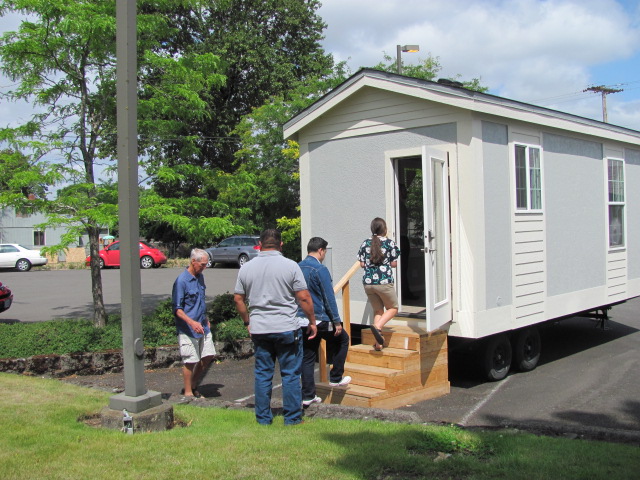
The Work Group toured the Green Flex housing unit in United Way's parking lot.  The unit was built by 20Twenty, a local company that owns the green flex patent.  The unit cost $46K, and was 100 SF smaller than what United Way is looking for.

Regional CoC Developments:  Jan Calvin shared information about the second meeting with area homeless services providers (see "HUD Joins 2d Regional CoC Providers Convo"), a project time line, and a chart showing which entities will probably be on the CoC Development Council.  Asked about Yamhill County's possible reconsideration if its decision to remain in the ROCC, she advised that the meeting between Yamhill County and Yamhill County mayors had still not been scheduled.  She also advised that a memorandum of agreement was in the process of being vetted by all parties' legal counsel.

It was agreed unanimously to cancel the August meeting, and reconvene on September 9, at the usual time and place.  

Members Rebecca Knight and Pamala Garrick in the Green Flex unit

Thursday, June 13, 2019

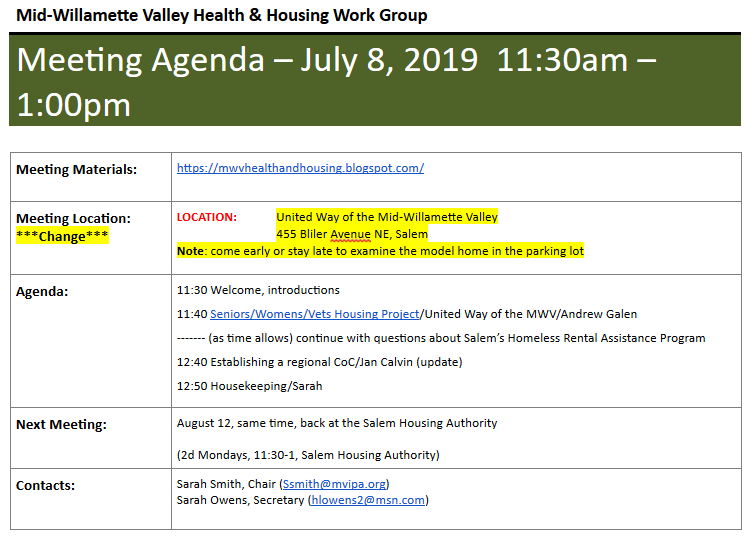
8 July 2019 Agenda


10 June 2019 Meeting Notes

Present:  Sarah Smith, Chair, and Sarah Owens, Secretary; Presenters Emily Reiman, Jimmy Jones, William Strawter, Harley Merck (new);  with Members Pamala Garrick, Eddie Maestas, Kristin Kuenz-Barber, Rebecca Knight, Erin Grimshaw (new), Shelly Ehenger, Dana Schultz (new), Chris Jones, and Michael Livingston (see Roster tab, above).

Regional CoC Developments:  following up on the discussion at last month's meeting regarding the effort to form a regional Continuum of Care (CoC), Emily Reiman shared with the group NEDCO's experience with the CoCs in Lane and Clackamas counties.  She said Lane County's CoC appeared to be inclusive (lots of open meetings, etc.,), that was not her experience when trying to apply for funds.  She said the same legacy grantees were funded year after year, despite questions in the community about their effectiveness.  It might even be the case that Lane County doesn't accept new project applications.  The Clackamas CoC was quite the opposite.  Emily said she had shared this with the consultant to the Mid-Willamette Homeless Initiative Steering Committee, Jan Calvin, and hoped the steering committee would strive to be inclusive when making governance decisions regarding the new regional CoC.

Salem, Polk and Marion counties have adopted resolutions supporting formation of a regional CoC.  Yamhill County initially declined support, but might reconsider.  There is division within Yamhill on the issue.  A clear majority vote in favor of separation is needed to satisfy HUD.  Yamhill also faces a timing issue.  The late May/early June deadline for adopting a resolution in support has passed, however any decision rests with the MWHI Steering Committee, which meets on June 25 from 3 to 5 at the Mid-Willamette Council of Governments.

Permanent Supportive Housing:  continuing his introduction to PSH using Lincoln Place, Vancouver WA, as a model of PSH congregate care, Jimmy Jones shared his experience with Salem's Homeless Rental Assistance Program (HRAP), which uses a scattered site model.  The formal program managed by the Salem Housing Authority (SHA) was launched July 2017 to serve the area's most vulnerable chronically homeless families/individuals.  Its success largely has depended on the availability of privately owned rental housing.  Participants were and continue to be referred by The ARCHES Project from a master list based on assessments using the VI-SPDAT and VAT.  Currently, participants are supported by three case managers (Christine Jeffries, Eddie Maestas and Jack Elliott) and SHA's Client Services Manager, Kimm McBeth.

As the program heads into its third year, 121 participants have been housed, 2 have died, 15 have been evicted, and 2 have left for other reasons.  The program budget and goals were recently "right-sized" (halved) to match what's felt to be realistic based on the limited housing supply, a move that caused  concern within the community about the success of the program.  On May 28, City officials met with providers to "discuss shifting resources to slightly lower needs clients than the 'hardest to house'" (see Bach, J. "Can Salem continue to pay for its 'housing first' program to get homeless off the streets?" (29 May 2019, Statesman Journal.)

During the meeting, Jones was asked what circumstances might justify shifting the program focus to lower needs clients, and whether doing so was likely to affect outcomes.  The discussion was just getting started when it was time to move on with the agenda, but it will be resumed at a subsequent meeting.  (In the interim, members might be interested to read this Permanent Supportive Housing Study, which concluded, "based on the variables included, there would have been no way to predict at entry into permanent supportive housing who would stay or leave, either positively or less so.")

Presentation:  Harley Merck and William Strawter presented a proposal for a project that would explore:  1) the use of existing state and county models to develop tiny home communities by private individuals or businesses;

2) community concerns for tiny home developments; 

3) county and city regulations, ordinances, building codes, safety concerns, and security concerns;

4) overall profitability for the private or business investor; and

5) result in a deliverable business plan to be used by low income housing advocates to encourage private land owners and developers to build tiny villages, as both a benefit to the community and a viable business investment.

The group offered comments and suggestions, including taking a look at The United Way of the Mid-Willamette Valley's efforts in this area.

Action:  the work group also adopted a charter (see tab above).   

Tuesday, May 14, 2019

13 May 2019 Meeting Notes

Present:  Sarah Smith, Chair, and Sarah Owens, Secretary; Presenters Jan Calvin (new),  Alison McIntosh, and Jimmy Jones;  with Members Pamala Garrick, Kim McBeth, Christie Hughes, Kristin Kuenz-Barber, Rob McAdam, Rebecca Knight, Jeramy Steele, William Strawter (new), Carolyn Fry (new), Connor McDonnell, Emily Reiman, Shelly Ehenger, Cameron Ross (new) and Michael Livingston (see Roster tab, above).

Guests:  Dede Hazzard and Raleigh Kirschman, both with the Union Gospel Mission Men's Shelter.

Slide from Calvin's Presentation
Jan Calvin, consultant to the Mid-Willamette Valley Council of Governments and the Mid-Willamette Homeless Initiative Steering Committee, gave a presentation on the steering committee's recommendation to (re) establish a local Continuum of Care.

Links to a white paper and the long form of the presentation are posted on the May 13 Agenda.  Emily Reiman said she had experience working with the CoCs to the north (Clackamas County) and south (Lane County) and agreed to share a few remarks about her experience at the June meeting. 

The members present agreed to provide a letter supporting the establishment of a local CoC.  See here.  

Alison McIntosh with Neighborhood Partnerships/Oregon Housing Alliance provided a legislative update and answered questions.  The last  revenue forecast is due out soon, at which point lawmakers will know what they have to work with.  The Governor wants $20.5M in General Fund dollars for homeless families and $50M for permanent supportive housing.  HB 2802 would provide aging-in-place resources.

Jimmy Jones offered remarks on permanent supportive housing (PSH) models generally (scattered site versus congregate) and his experience with Lincoln Place, a permanent supportive housing project developed by a partnership between Share, the Council for the Homeless, the Vancouver Housing Authority (vouchers) and Key Property Services.  Among the lessons learned was the importance of putting the right people next to the right people and designing for people with a heightened/extreme sense of danger, despite its effects being difficult to anticipate.  Asked how the project dealt with vouchers' clean/sober requirement, Jimmy indicated it was liberally interpreted not to be a barrier.  He said he's working to get 50 of the 500 PSH units the Governor is asking for, but feels the legislature  "isn't taking [the need for PSH] seriously."

Pamala Garrick and Christie Hughes agreed to present on three other congregate permanent supportive housing developments at the June meeting.  William Strawter asked to present in June on his project to explore the feasibility of developing low income housing using a private enterprise, for-profit tiny-house village model.  For a history of such efforts in Salem, see "Sanctioned Camping."

The members present agreed they wanted to continue meeting during the summer, to have a legislative debrief at the July meeting, and thereafter to pursue the plan reviews discussed at the February meeting (see Plans tab above).  

re Forming a Local CoC